Learn AWS by doing.
An OpenEnv-compatible RL environment where agents execute real AWS CLI commands against a vendored MiniStack simulator that responds with production-equivalent JSON. 120+ tasks across 5 tiers (warmup → expert) with adaptive selection, mastery tracking, spaced repetition, chaos injection and drift-detection scenarios — every feature designed to keep the reward signal honest and prevent the agent from gaming it. Trained end-to-end with a 1,500-row synthetic SFT dataset and TRL GRPO with 8-way parallel rollouts on a single GPU.
List resources — single read-only commands
- Run one AWS CLI command to list or describe a resource type
- S3 buckets, EC2 instances, DynamoDB tables, Lambda functions, RDS, EBS volumes
- Graded by command_match — checks operation + service pair
- No setup required, no state mutations
Create single resources with verification
- Create an S3 bucket, DynamoDB table, SQS queue, or Lambda function
- Graded by resource_creation — verifies the exact resource exists in AWS Infrastructure Simulator
- Introduces resource name validation — "my-bucket-2" won't satisfy a check for "my-bucket"
- First tier where idempotency bonus (+0.02) can be earned
Multi-step workflows — create, configure, connect
- Ordered sequences: create a bucket then enable versioning, create a table then add an item
- Graded by multi_step — validates each step was completed in order
- Chaos injection begins at 10% probability — resources may be silently mutated mid-episode
- Rollback penalty (-0.1) starts to matter with multi-step create/delete patterns
Cross-service architectures spanning multiple AWS services
- Wire Lambda to SQS, configure API Gateway with integrations, build event-driven pipelines
- Graded by multi_step + services — all required services must be configured
- Chaos injection escalates to 20% probability — DynamoDB throughput, Lambda configs may change
- Hints cost more: 3 hints = only 61% of max reward (0.85³ decay)
SRE incidents & drift detection — diagnose and fix
- Fix overly permissive S3 policies, replace broad IAM inline policies, repair broken infra
- Graded by state_checks — actual CLI commands run against MiniStack at grading time
- Chaos injection at 30% probability — maximum perturbation frequency
- 9 drift detection tasks — correct infra is provisioned, then 2–3 random mutations applied from a pool
- Agent must audit environment, discover which resources drifted, and fix only those
- Drift is randomized per episode — prevents memorization of fix sequences
Curriculum & Training
Adaptive learning system that tracks mastery and selects optimal tasks.
Reward Shaping
Dense reward signals that encourage operational discipline and real progress.
Resilience & Adaptability
Features that test agent robustness under unpredictable conditions.
Security Posture Audit
Tests reasoning about configuration state — working but insecure infrastructure the agent must analyze and harden.
Anti-Reward-Hacking
8 defense layers that prevent the agent from gaming the reward system.
aws CLI commands allowed
SFT → GRPO Training Pipeline
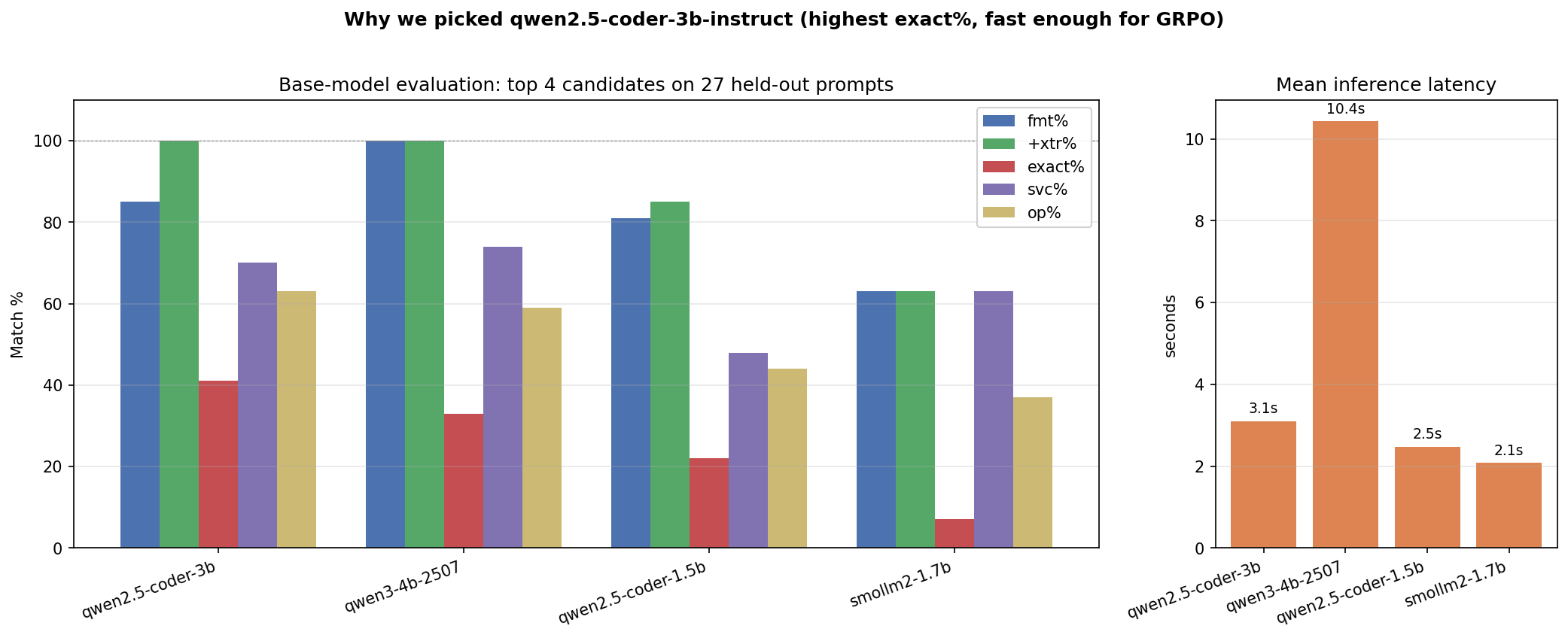
Two-stage training on unsloth/Qwen2.5-Coder-3B-Instruct-bnb-4bit — the
base picked from an 11-model benchmark on 27 held-out prompts. Stage 1: LoRA SFT on 1,500 synthetic
trajectories spanning 5 shapes. Stage 2: TRL GRPO with multi-turn rollouts, group-relative advantages, KL
to SFT reference, and Optuna search over an 8-dim hyperparameter space.
Base-Model Selection
11 chat models × 27 held-out prompts. Qwen2.5-Coder-3B-Instruct wins on every metric that matters: 41% exact match, 63% operation match, 3.1 s/call (3× faster than the 4B runner-up).
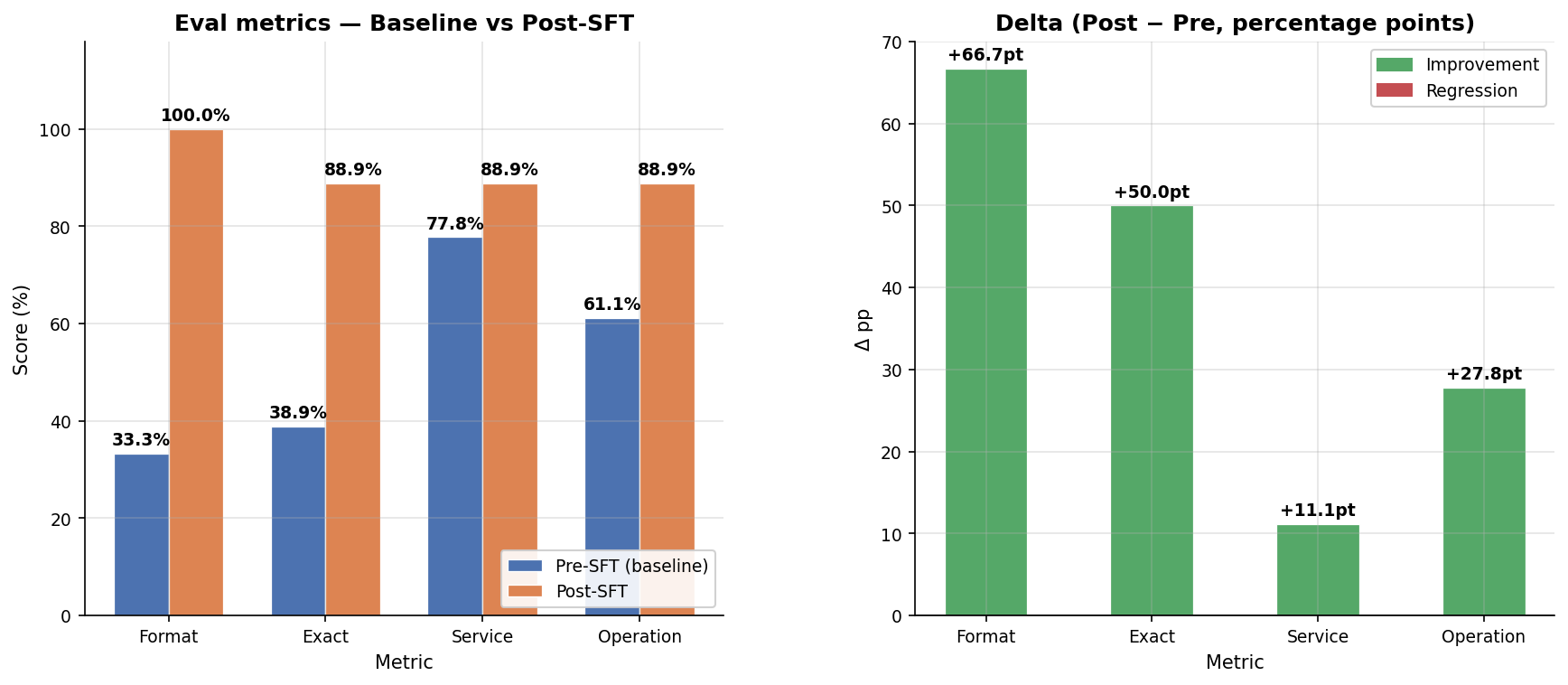
Base vs SFT — Eval Delta
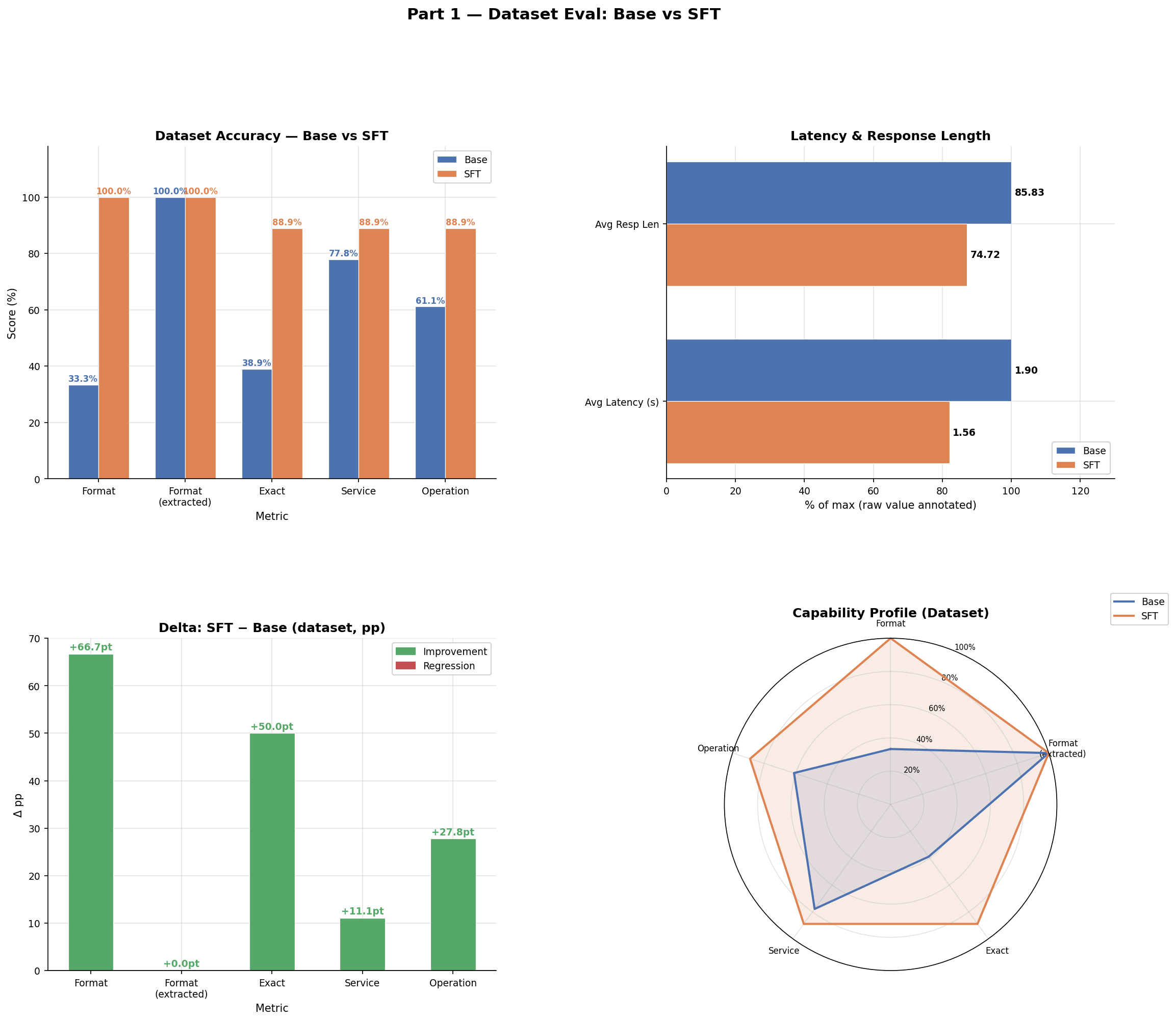
After running the SFT pipeline end-to-end, format compliance is now perfect and exact-match jumped from 39% to 89%.
| Metric | Base | Post-SFT | Δ |
|---|---|---|---|
| Format | 33.3% | 100.0% | +66.7 pp |
| Exact match | 38.9% | 88.9% | +50.0 pp |
| Service match | 77.8% | 88.9% | +11.1 pp |
| Operation match | 61.1% | 88.9% | +27.8 pp |
| Latency | 2.03 s | 1.40 s | −0.63 s |
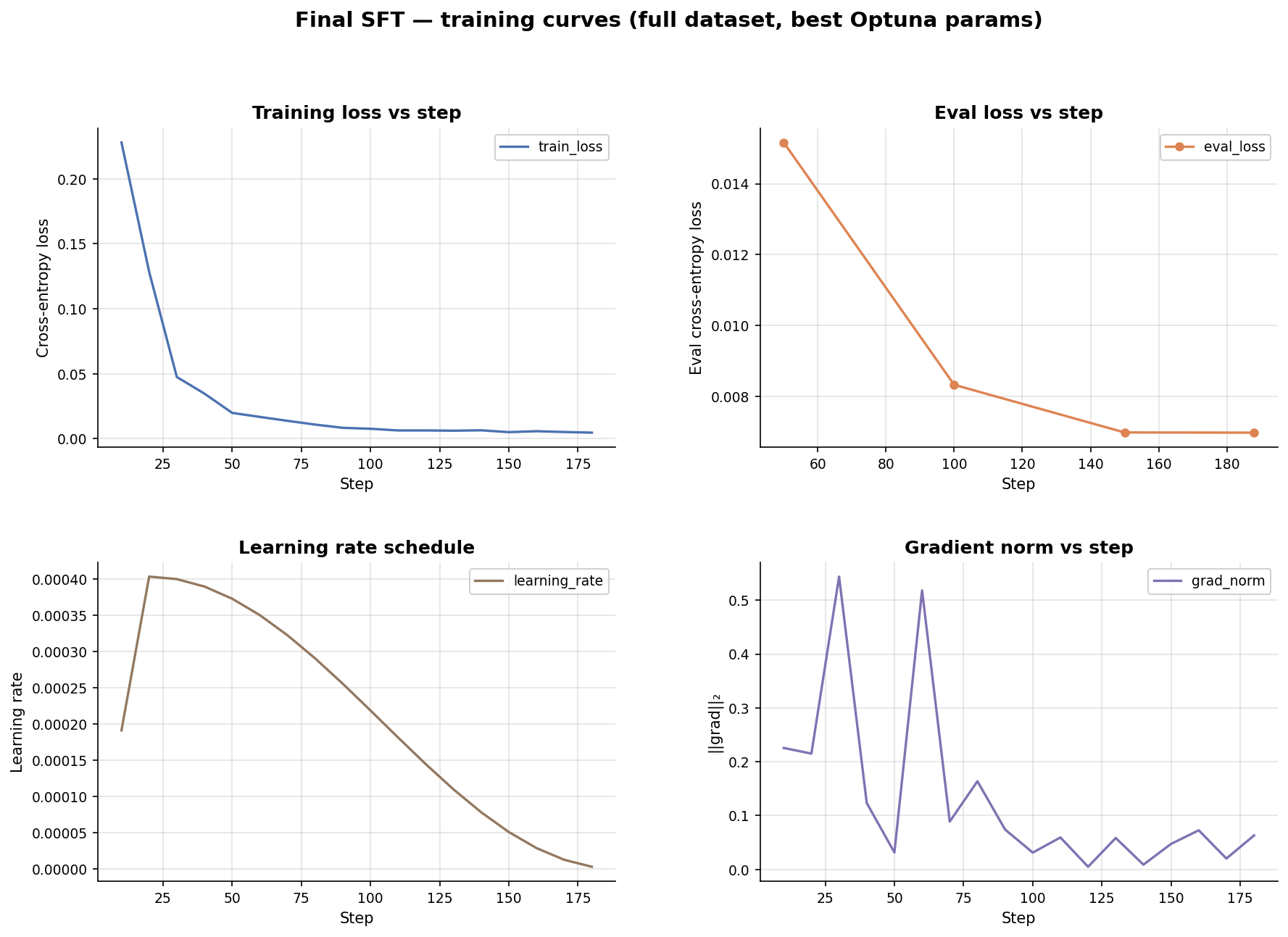
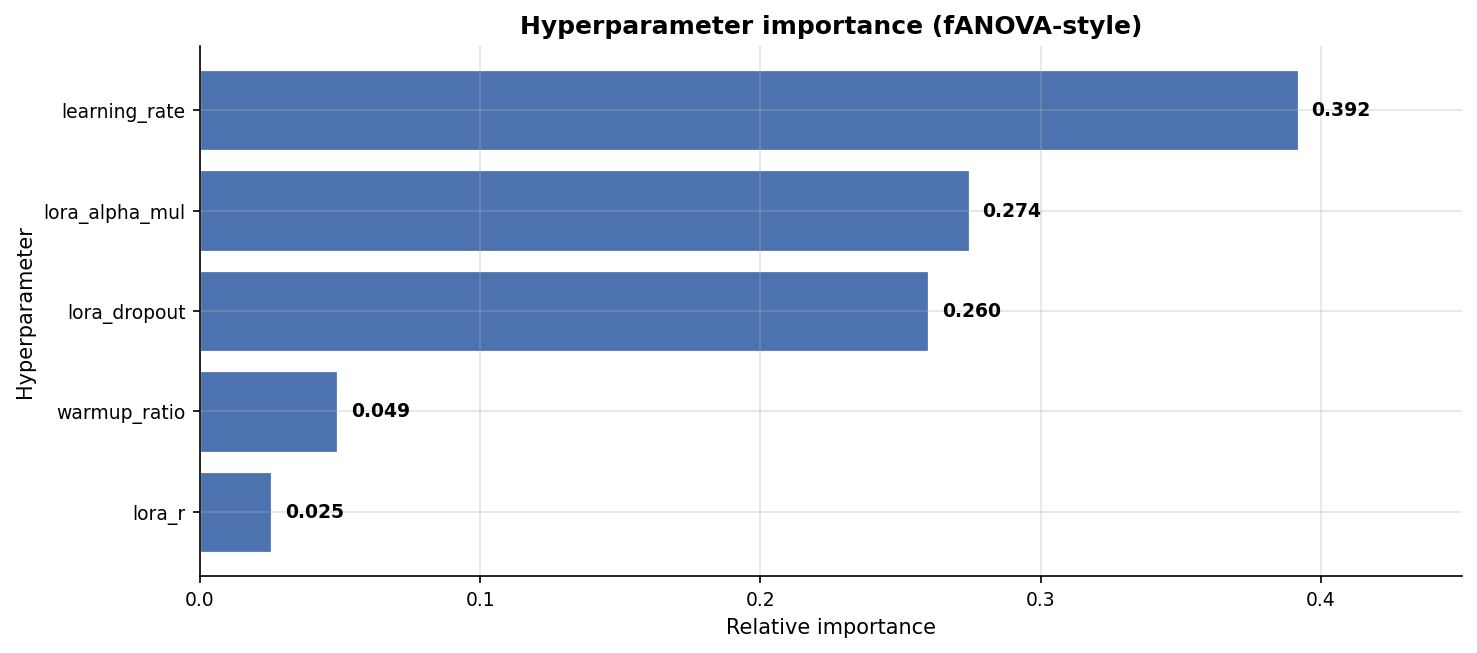
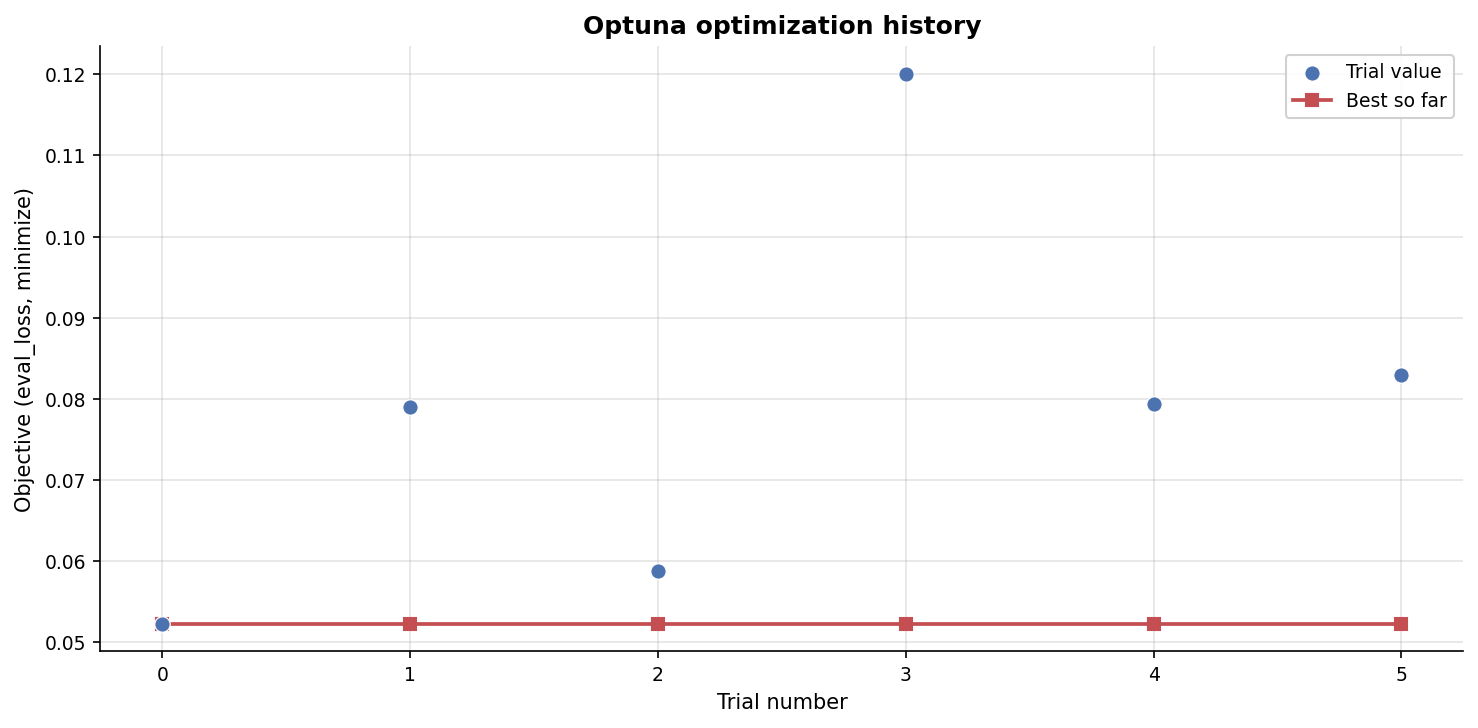
SFT Training Curves & Optuna
Best SFT trial (out of 6): lora_r=16, lora_alpha=16, dropout=0.0058, lr=4.03e-4,
warmup=0.1.
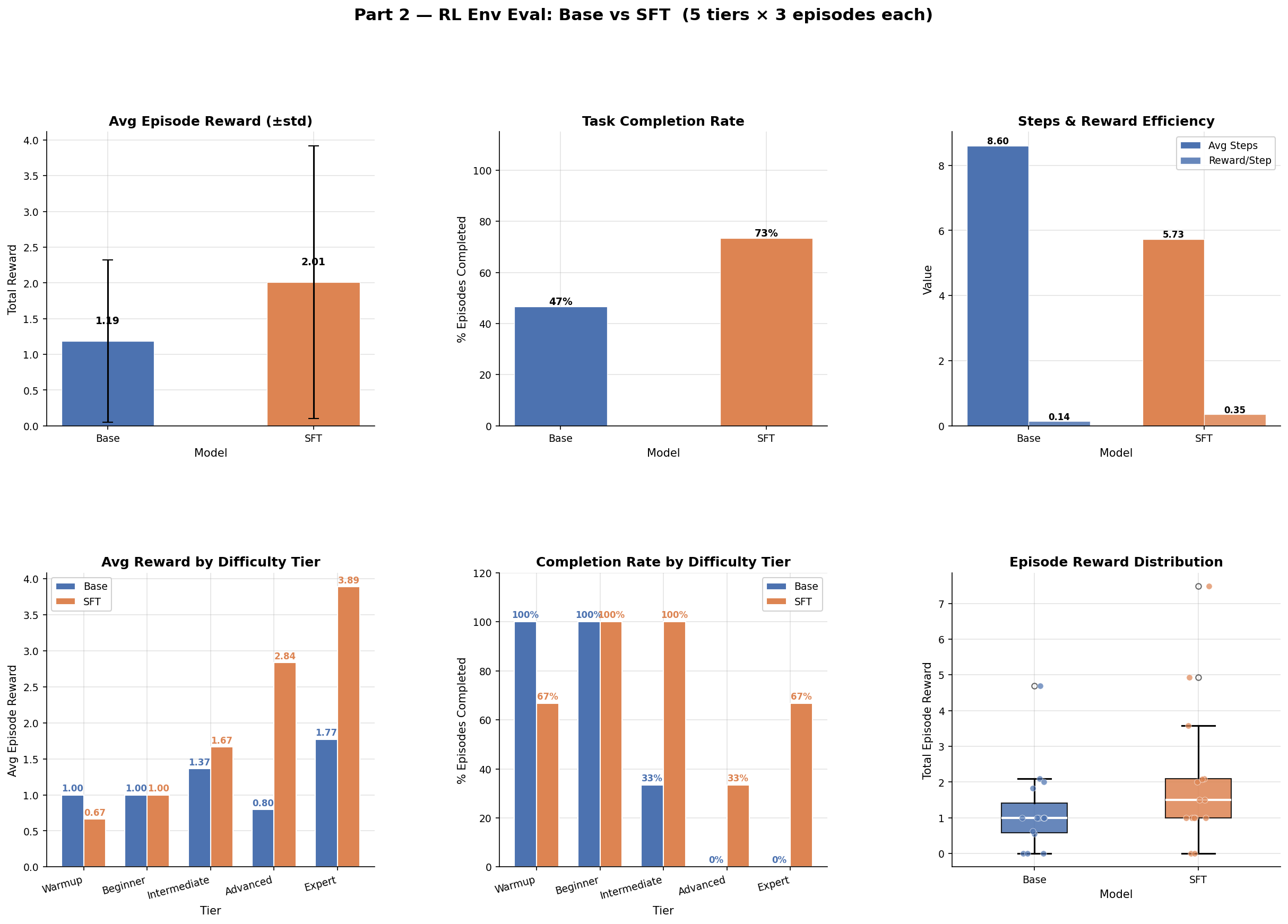
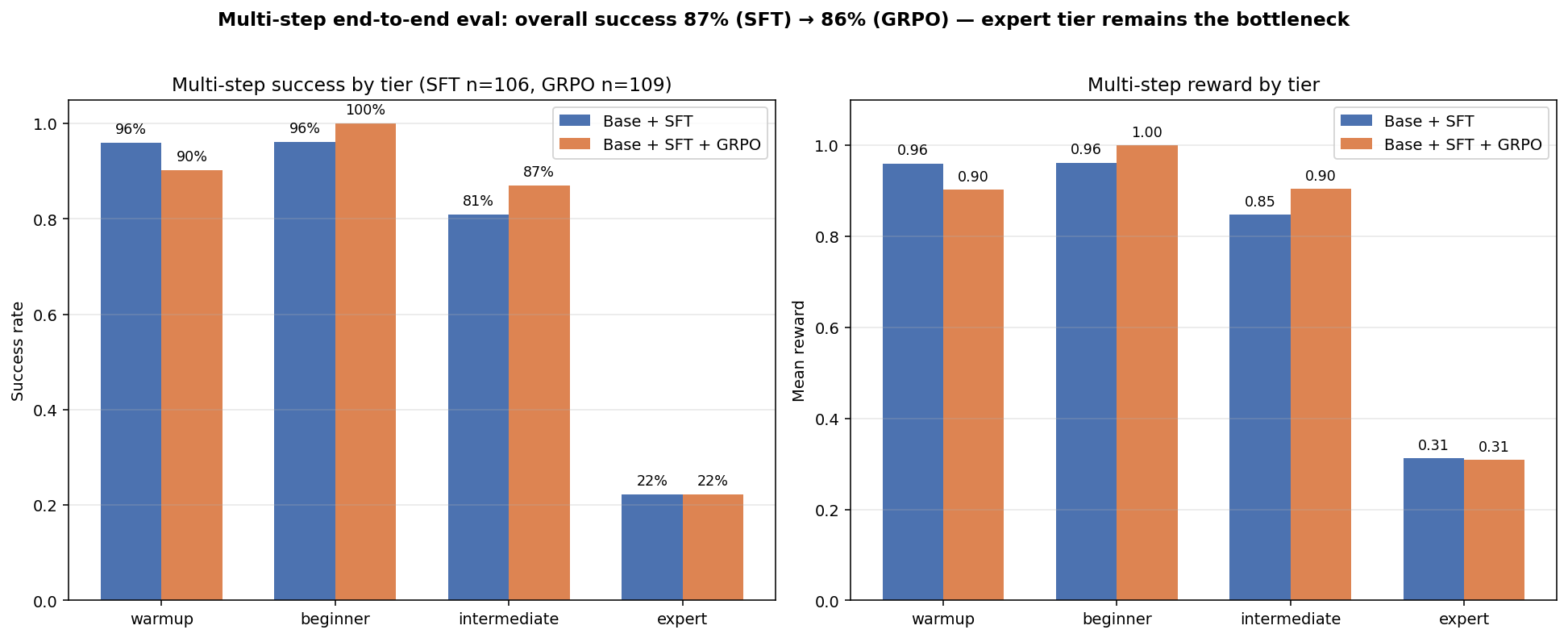
GRPO — Live Multi-step Env Eval
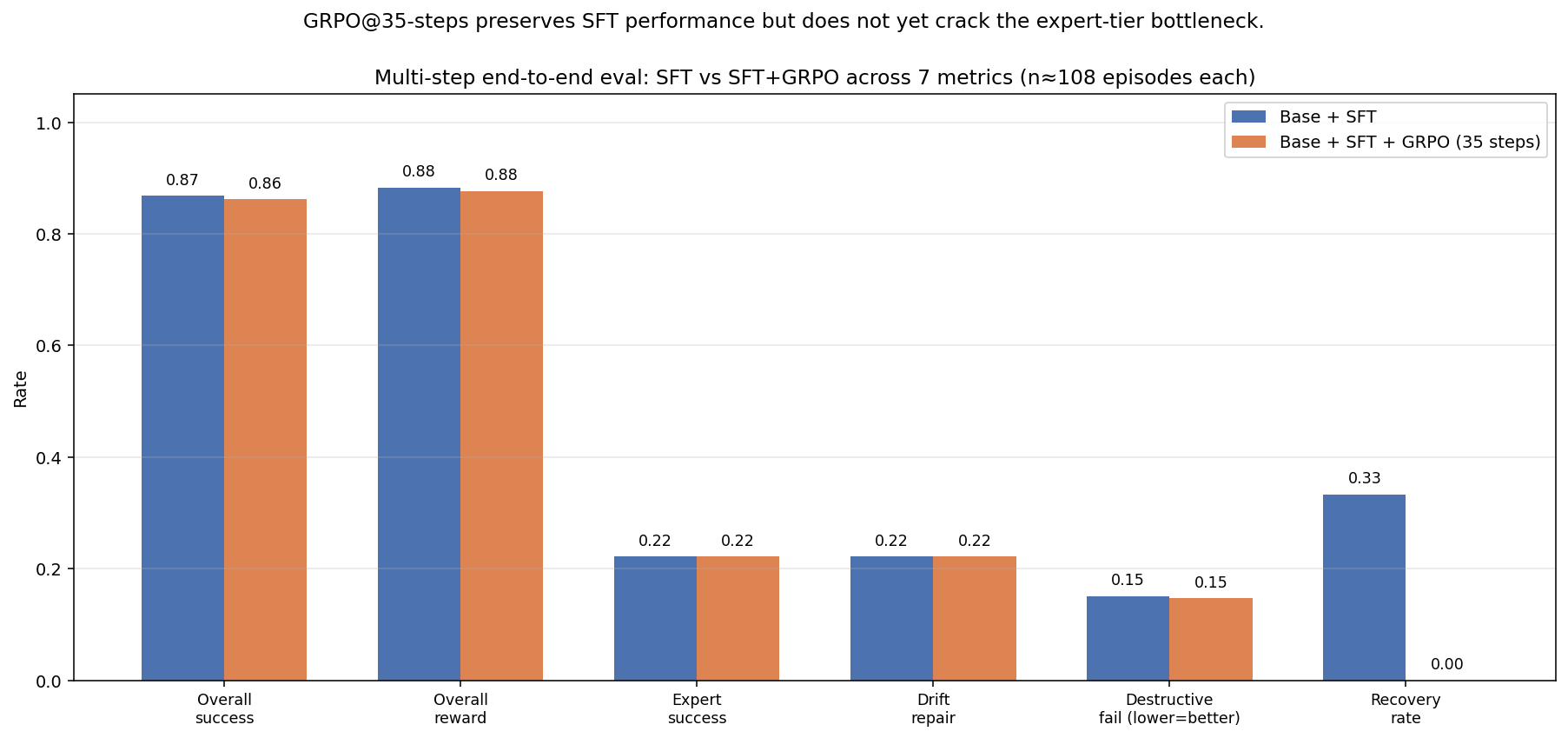
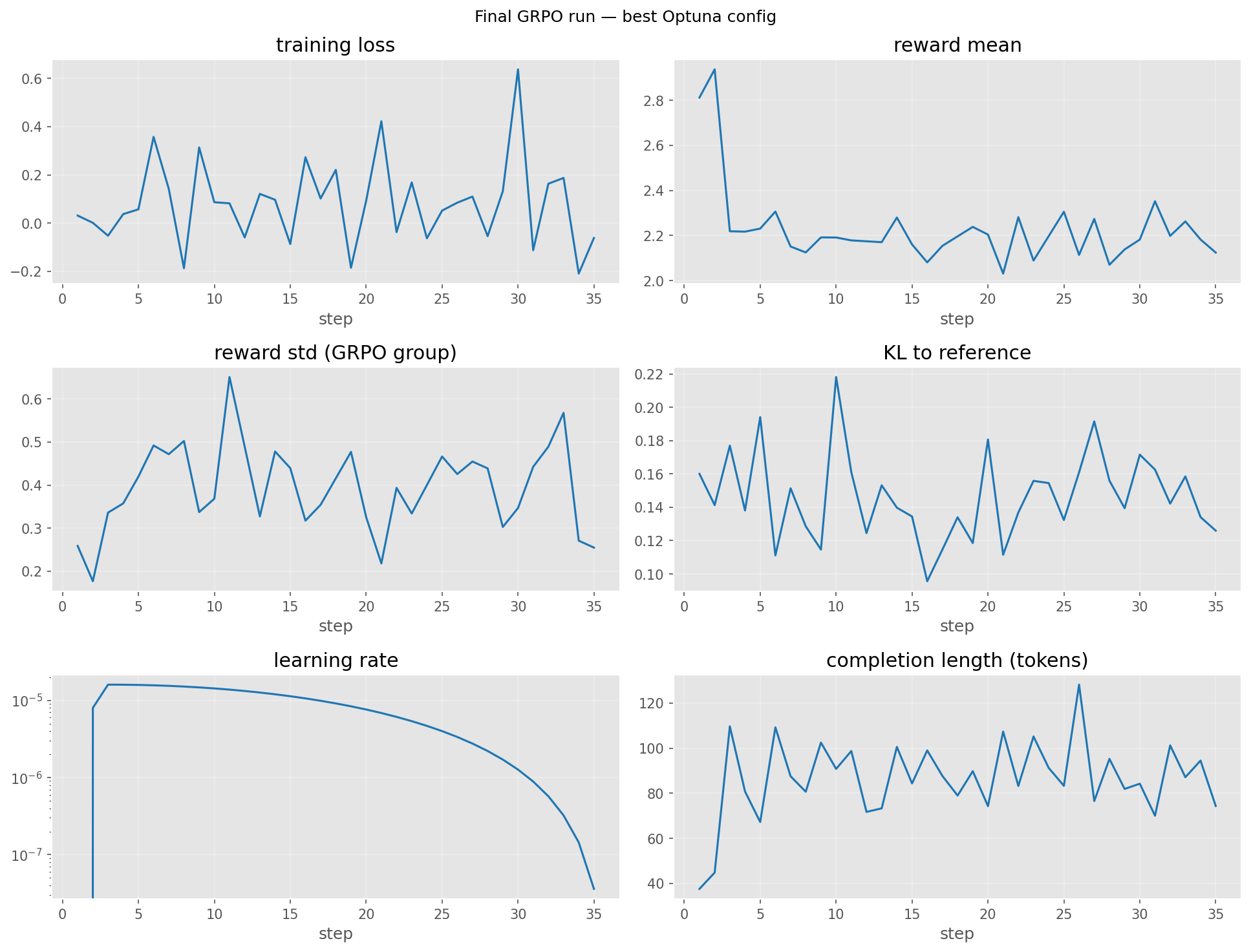
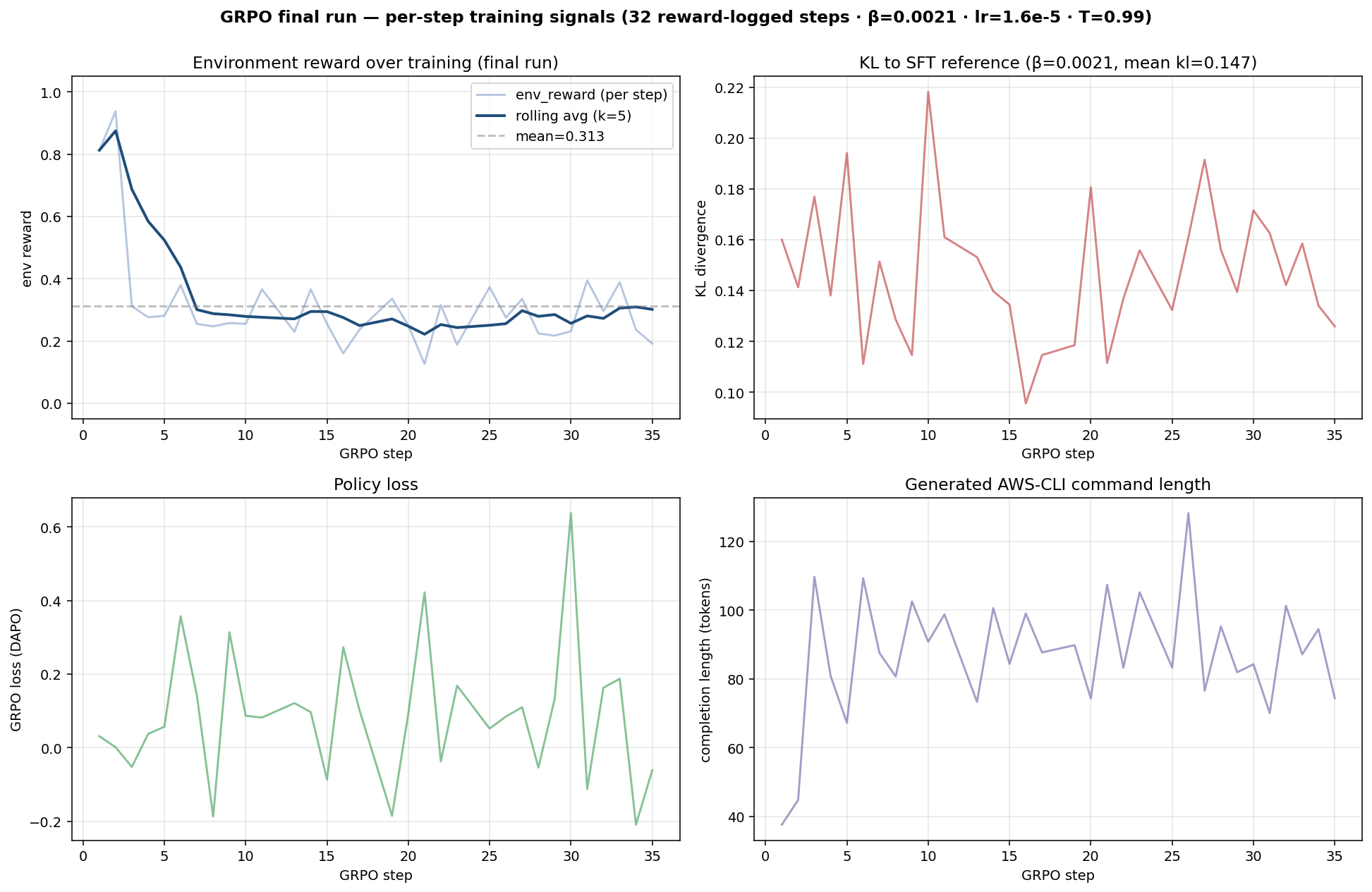
After 35 GRPO steps on top of the SFT adapter (best Optuna config: lr=1.6e-5, β=0.0021,
T=0.99), re-evaluated end-to-end on 100+ episodes.
| Metric | Base + SFT | + GRPO | Δ |
|---|---|---|---|
| Overall success | 86.8% | 86.2% | −0.5 pp |
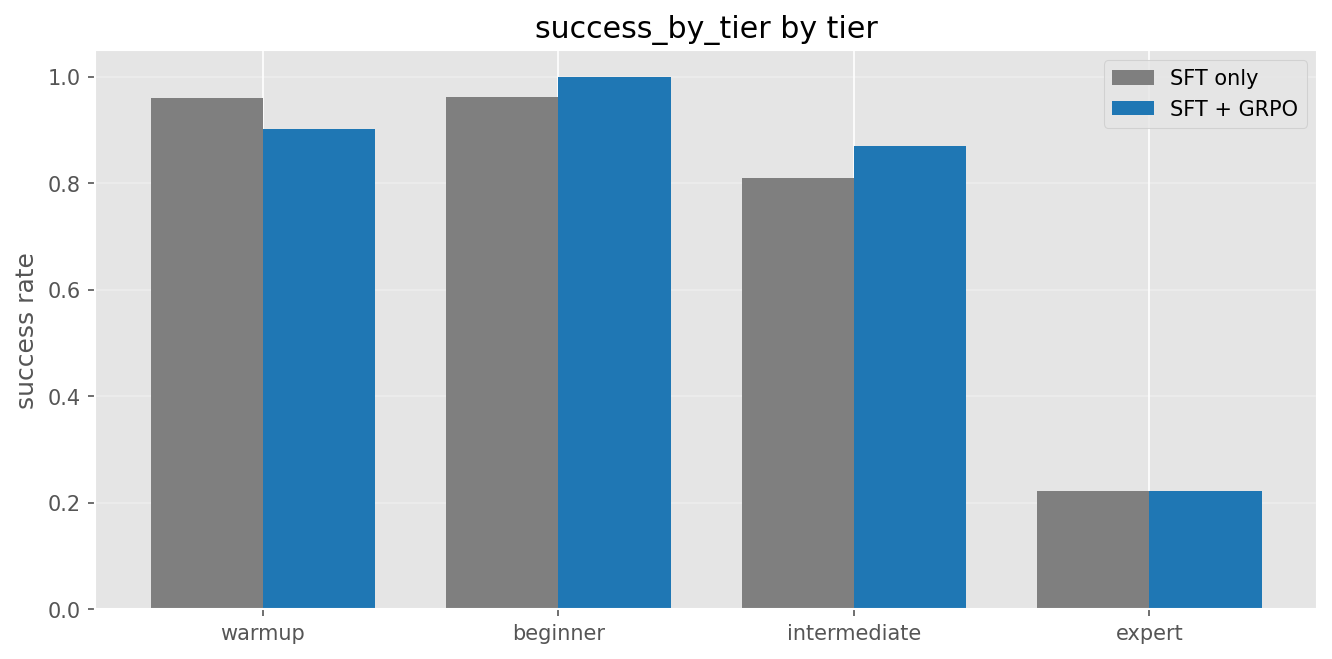
| Beginner | 96.2% | 100.0% | +3.8 pp |
| Intermediate | 81.0% | 87.0% | +6.0 pp |
| Expert | 22.2% | 22.2% | flat |
| Drift repair | 22.2% | 22.2% | flat |
| Destructive-action fail | 15.1% | 14.7% | −0.4 pp |
Honest reading: the 35-step GRPO run preserves the SFT gains and modestly improves the middle tiers, but does not crack the expert-tier bottleneck. Longer runs and more curriculum exposure to expert tasks are next.
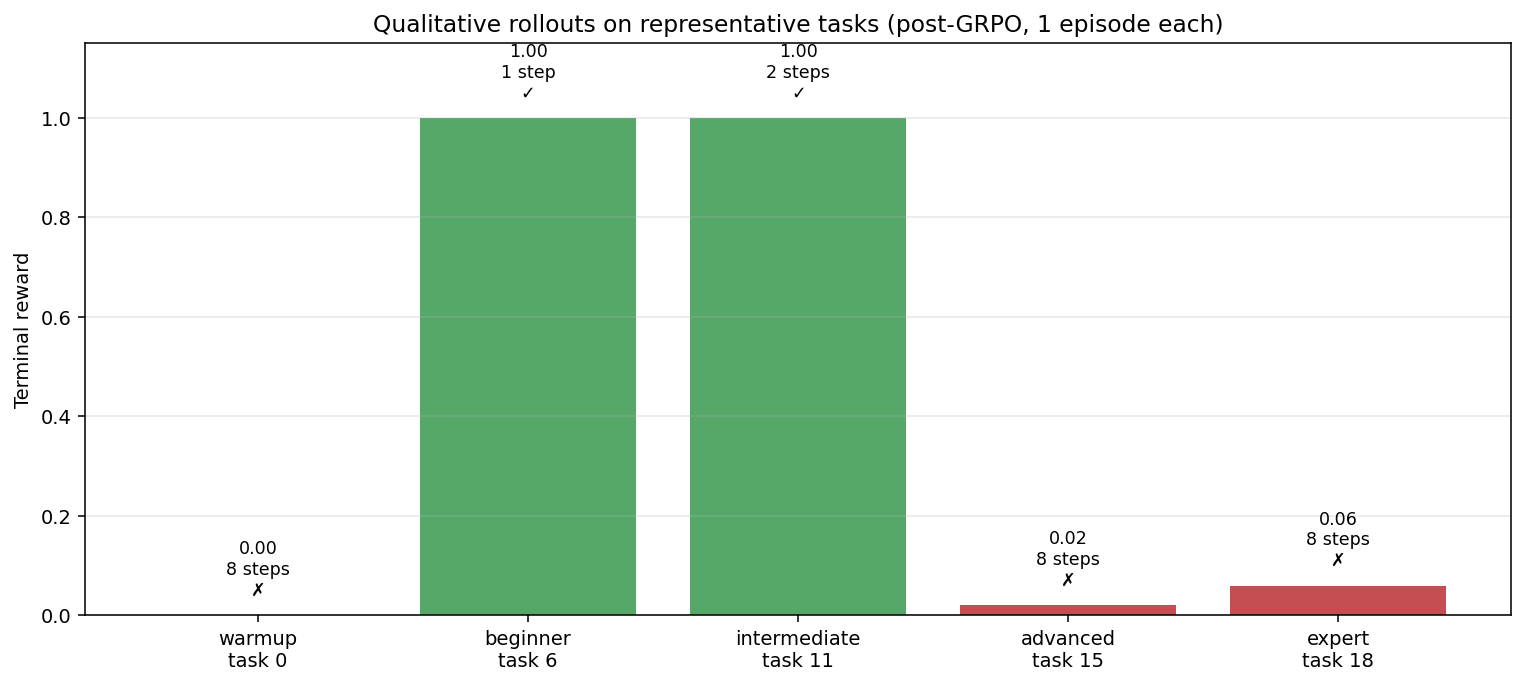
GRPO Training Curves
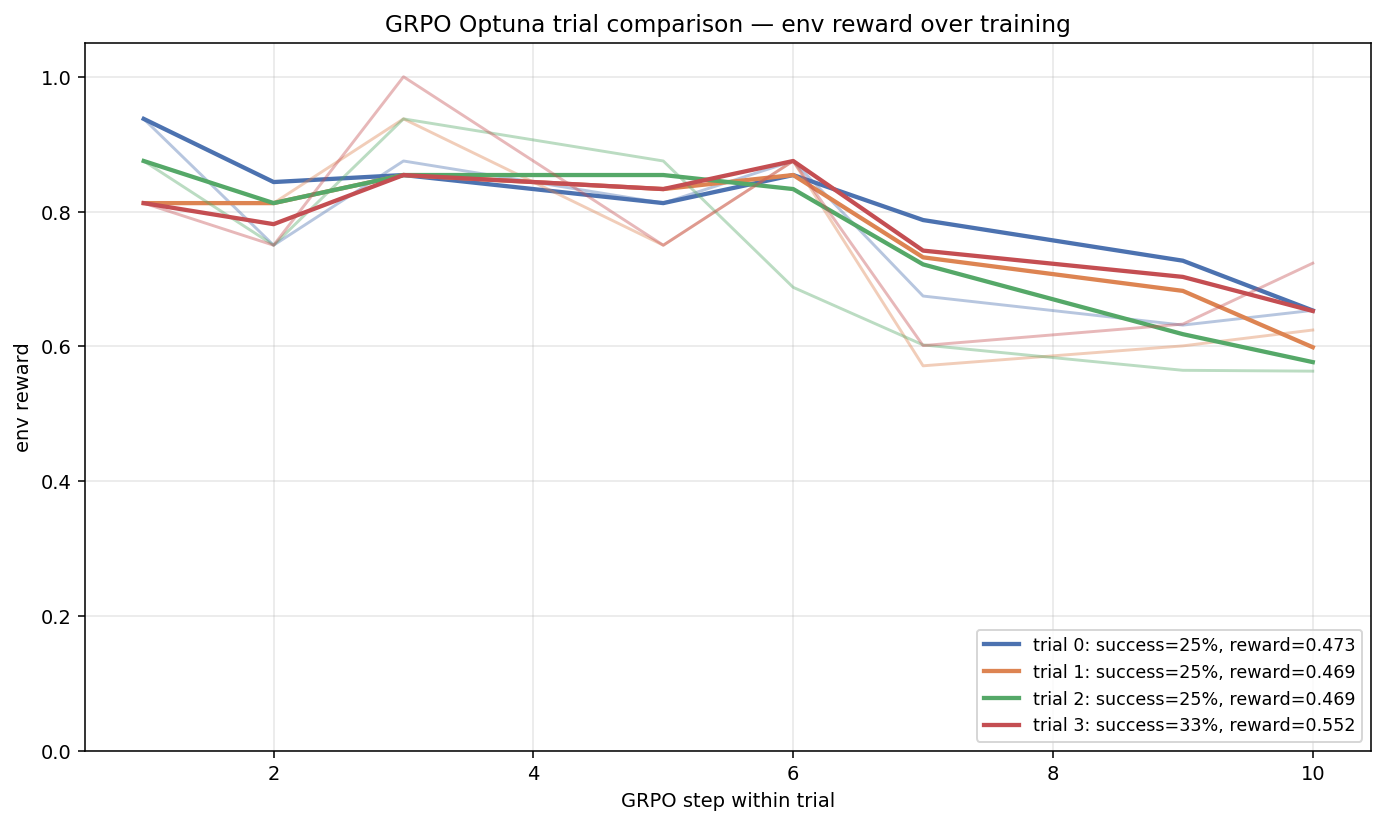
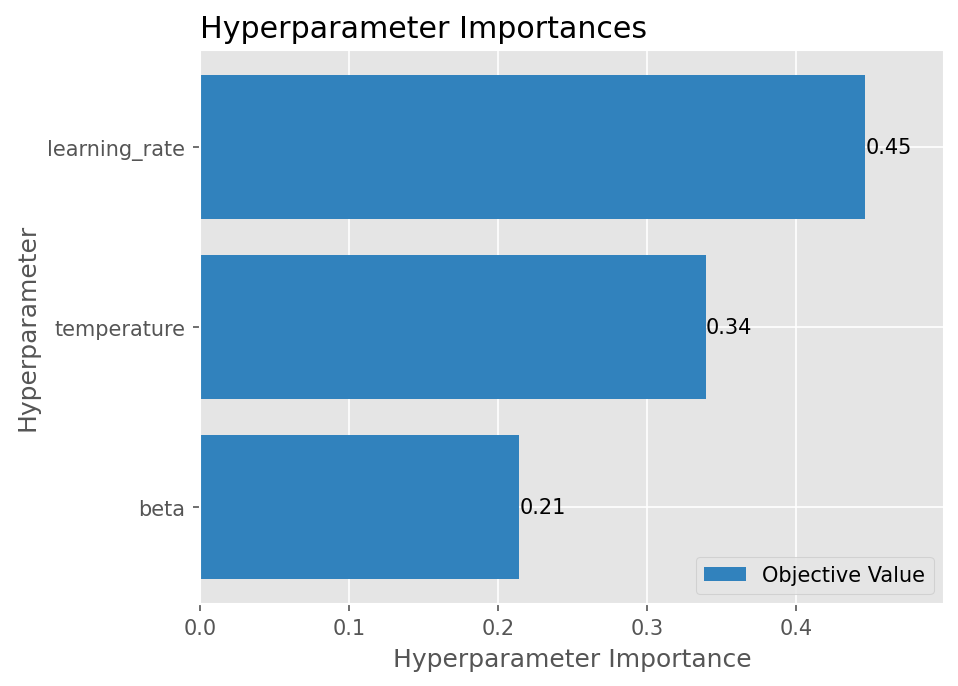
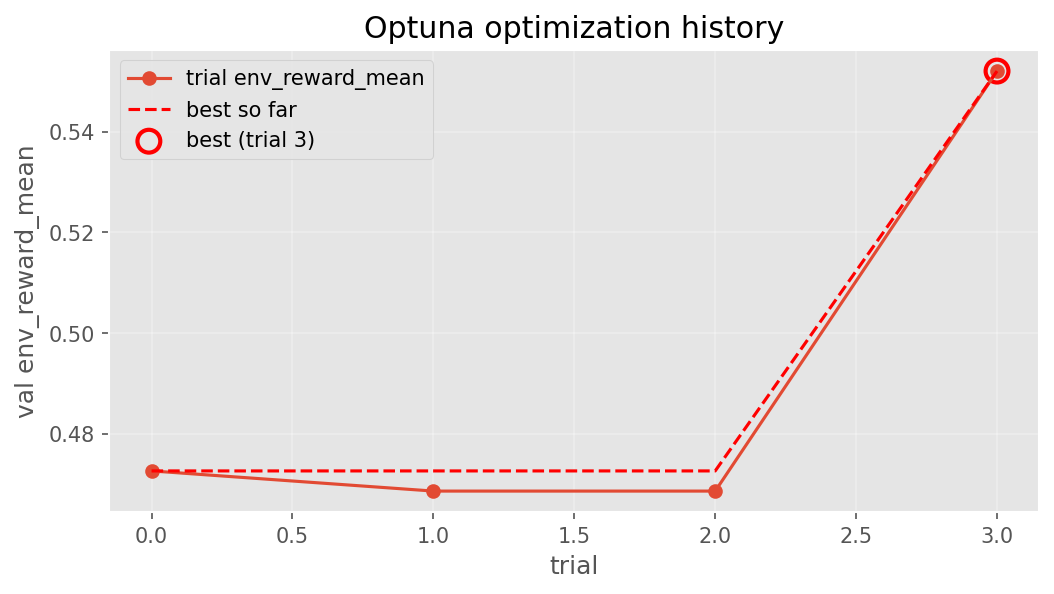
Per-step training signals from the final 35-step GRPO run, plus the 4-trial Optuna search that picked the final config.
WebSocket
Python Client
Click New Episode to start
The curriculum assigns a task matching your skill level
| # | Command | OK | Reward |
|---|---|---|---|
| No commands executed yet | |||
Start an episode to see live infrastructure state.
Build the Future of AI
Star it, fork it, break it, fix it — every episode makes AI agents better at cloud operations.